
Dental AR Quality and Equipment Investment: What the Benchmark Data Reveals
Jul 02, 2026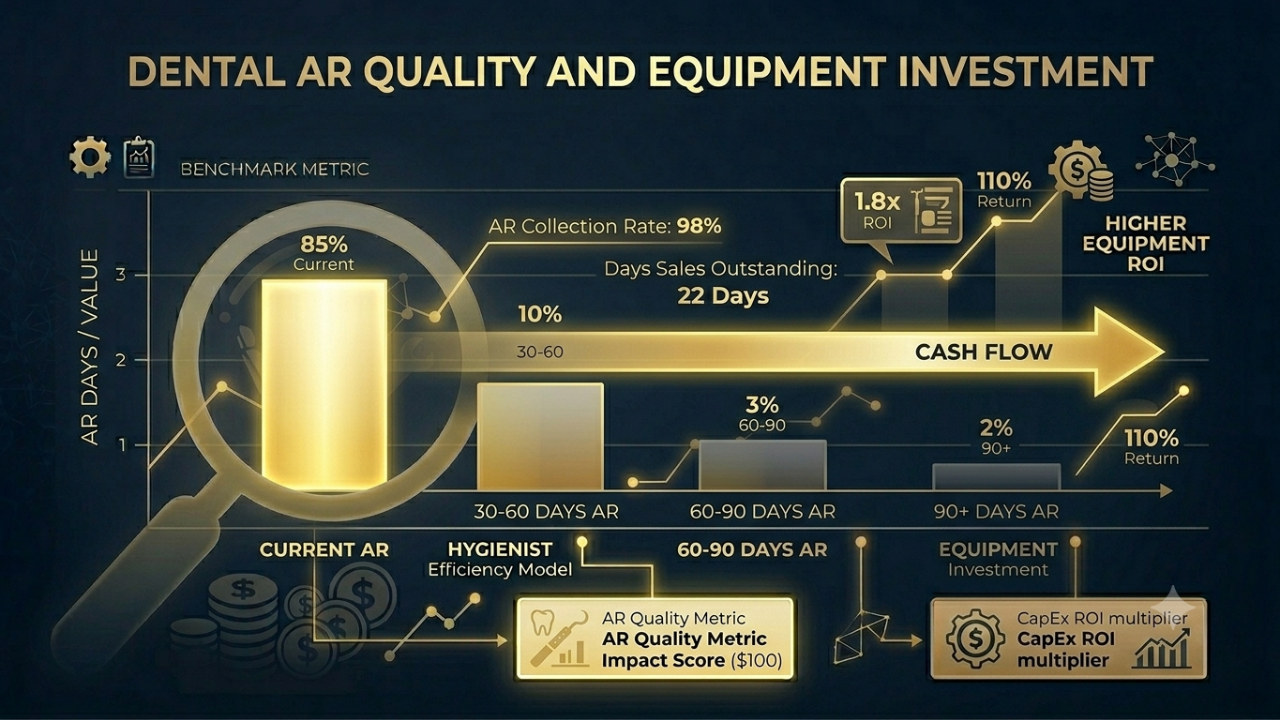
Accounts receivable is one of the most misunderstood assets on a dental practice's balance sheet — and one of the most scrutinized in a DSO acquisition or practice financing event.
The reason: AR quality varies enormously. A $300,000 AR balance that's 85% current (0–30 days) is a very different asset than one that's 40% aged over 90 days. The former is nearly fully collectible. The latter is worth significantly less than face value once collection probability is applied.
For practices with significant equipment assets, understanding AR quality matters for two reasons: it affects the cash available for equipment investment and maintenance, and it's one of the first things a DSO buyer or lender examines when evaluating a practice.
What the AR Benchmark Data Shows
The DSI Benchmark Index tracks two AR quality metrics for all contributing practices:
AR Days Outstanding (A6): Total AR ÷ average daily net production.
| Percentile | AR Days | |---|---| | P10 (best) | 15 days | | P25 | 22 days | | P50 (median) | 35 days | | P75 | 52 days | | P90 | 72+ days |
AR Over 90 Days (A7): Percentage of total AR aged beyond 90 days.
| Percentile | 90+ Day Percentage | |---|---| | P10 (best) | 2% | | P25 | 6% | | P50 (median) | 15% | | P75 | 28% | | P90 | 40%+ |
A practice at the P75 on both metrics — 52 AR days and 28% aged over 90 — has a material cash conversion problem relative to peers. The revenue is there on paper; it's just not in the bank.
How AR Quality Affects Equipment Investment Capacity
The connection is practical: AR quality determines when cash arrives, which determines when it can be deployed.
The delayed cash example:
A practice with $2M in annual collections at 52 AR days has approximately $285,000 in outstanding AR at any given time. A practice of the same size at 28 AR days has approximately $153,000 outstanding. The difference — $132,000 — is cash the first practice is waiting for while the second has already collected.
That $132,000 is the difference between funding an equipment purchase in cash vs. requiring financing, or between having a comfortable reserve for an unexpected equipment failure vs. scrambling for emergency credit.
Practical implication: Before a major equipment investment, run the DSI AR & Collections Analyzer. If your AR days are above P50, a 60–90 day AR cleanup initiative will generate real cash — often enough to reduce or eliminate the financing needed for equipment.
What Acquirers Do With AR in a Practice Sale
AR quality becomes a valuation issue in any acquisition or financing event.
The standard DSO approach to AR:
AR under 60 days is typically treated as a fully collectible asset at or near face value. AR aged 61–90 days gets a 15–25% discount. AR over 90 days is either excluded entirely or purchased at 30–50 cents on the dollar.
The math for a practice with $400,000 in total AR:
- If 70% is current and 8% is over 90 days: effective value ≈ $370,000
- If 45% is current and 35% is over 90 days: effective value ≈ $290,000
That $80,000 difference appears in the deal as a working capital adjustment or escrow holdback.
Collections Rate: The Companion Metric
Collections rate — net collections ÷ net production — measures the ongoing efficiency of the revenue capture process.
Benchmark: P50 is approximately 98%. Below 95% requires explanation. The most common causes: patient balance write-offs, unpursued insurance denials, and billing staff capacity gaps.
For equipment investors, collections rate determines the effective yield on every procedure. A practice with 94% collections rate on $2M in production is leaving $80,000+ annually uncollected — which is also $80,000 less available for equipment investment or debt service.
Common Questions
How quickly can AR quality realistically be improved? With dedicated follow-up, most practices can meaningfully reduce their 90+ bucket within 60–90 days: weekly insurance follow-up on denied claims, patient balance calls starting at 45 days, and a clear write-off policy so aging AR gets resolved.
What's the right collections rate before a practice sale? 97–101% raises no questions in diligence. Below 95% requires a ready explanation.
Should I hire an RCM service to clean up AR before going to market? For practices with 90+ day percentages above 25%, a 90-day RCM engagement before market often generates more in recovered AR and improved valuation than it costs.
Related Reading
- What DSO Buyers Are Looking at Beyond EBITDA
- How Your Dental Overhead Ratio Affects Your Acquisition Offer
- PPO Write-Off Rates and Equipment ROI
- Dental Equipment Valuation for Practice Sales: What Buyers Actually Look At
Find out where your AR quality sits relative to peer practices.
The DSI AR & Collections Analyzer benchmarks your AR days, 90+ bucket percentage, collections rate, and denial rate — and estimates the realistic collectible value of your current 90+ AR balance.
Run Your Free AR & Collections Analysis →
Free. Nine inputs from your PMS AR aging report. Under 5 minutes.