
What DSO Buyers Are Looking at Beyond EBITDA — and How Benchmark Data Changes the Deal
Jun 18, 2026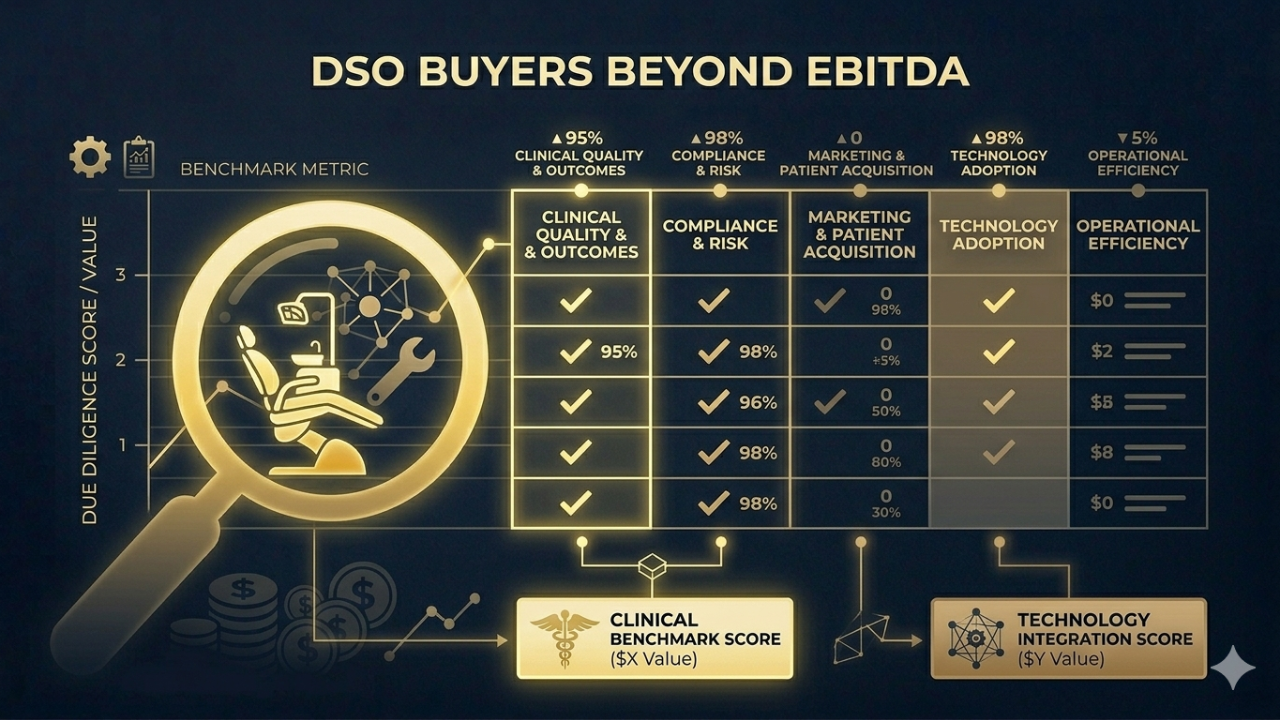
DSO acquisition due diligence has gotten more rigorous in the last three years. PE-backed platforms are running tighter financial underwriting, lenders are asking harder questions, and buyers who got burned on deferred capex in early-cycle acquisitions are building those lessons into their diligence checklists.
One area that's changed significantly: how buyers are using operational benchmark data — not just equipment inventories — to assess practice quality before making an offer.
The DSI Benchmark Index is the first independent, practice-level operational benchmark in dentistry. Here's how sophisticated buyers are starting to use it, and what it means for sellers preparing for market.
What Buyers Are Looking For Beyond EBITDA
A practice producing $3M in collections with 28% overhead isn't just an EBITDA number. It's a signal about operational maturity — about whether the practice has been managed intentionally or has just been producing well despite itself.
The metrics that matter most to DSO acquirers in 2026, ranked by diligence frequency:
1. Collections rate and AR quality Collections rate (A4) and AR days outstanding (A6) tell a buyer whether revenue is being captured efficiently. A practice with $3M in production but a 91% collections rate and 55 AR days is leaving $90,000+ on the table annually — and the buyer is looking at whether that's a systems problem or a structural one.
2. Staff cost ratio Total non-doctor payroll + benefits ÷ collections (C1). This is the most commonly adjusted metric in acquisition underwriting. A practice at 34% staff cost ratio with above-median production tells a very different story than one at 34% with below-median production. The ratio only makes sense in context — which is why peer benchmarking matters.
3. Hygiene utilization and reappointment Hygiene capacity utilization (B2) and reappointment rate (B3) are forward-looking indicators of practice health. Low reappointment rate means the active patient base is eroding and will require expensive new patient marketing to sustain. DSOs acquiring a practice with 45% reappointment are buying a leaky bucket.
4. PPO write-off rate and payor mix Write-off rate (D2) and payor mix (D1a-c) determine the quality of the revenue stream. A practice with 75% PPO concentration and a 40% write-off rate on those plans has structurally lower-quality revenue than its gross production implies.
5. Equipment age Average operatory equipment age (F5) flows directly into the capex adjustment that reduces net proceeds. We covered this in detail in a companion post.
How the DSI Benchmark Changes the Diligence Conversation
Before the DSI Benchmark Index, buyers had to rely on internal databases, industry rule-of-thumb, and their own acquisition history to assess whether a practice's metrics were strong or weak.
The DSI Benchmark gives sellers and their advisors an independent, third-party reference point for every metric category. A practice with a DSI Practice Health Score in the 70th percentile has documented evidence of operational quality that a 65th-percentile practice can't claim.
For sellers: A strong DSI scorecard is a marketing asset. It answers the "how do you compare to peers?" question with data instead of owner assertions.
For advisors and brokers: The benchmark provides an independent baseline for valuation discussions that doesn't rely on the buyer's proprietary comparables.
For DSO buyers: Practices that have been submitting data to the DSI Benchmark are self-selecting for operational transparency — they know their numbers, they track them quarterly, and they've seen how they compare. That's a quality signal in itself.
The AR Question Most Sellers Get Wrong
The single most common due diligence surprise in dental acquisitions: AR quality.
Sellers present AR balances as an asset. Buyers treat them as a liability — specifically, the 90+ day bucket. A $400,000 AR balance that's 38% aged over 90 days has an effective value closer to $280,000 once collection probability is applied. Buyers will either discount the AR in the purchase price or require escrow treatment of the 90+ bucket.
Running the DSI AR & Collections Analyzer before going to market tells you:
- Exactly where your AR days and 90+ percentage sit relative to peers
- The realistic collectible value of your current 90+ bucket
- Whether your denial rate suggests a billing process problem that buyers will find
Addressing these before the LOI is almost always worth it. A 90-day AR cleanup that reduces your 90+ bucket from 32% to 18% doesn't just improve your DSI score — it increases the asset value buyers assign to your AR balance.
Practical Pre-Market Benchmark Checklist
If you're planning a practice sale or DSO transaction within the next 18–24 months, here's the benchmark-driven preparation sequence:
12–18 months out:
- Run the Practice Health Scorecard and Overhead Analyzer to establish your baseline
- Identify which domain scores are below P50 — these are your improvement priorities
- Address staff cost ratio if above P75 (staffing model review)
- Begin proactive equipment replacement if average age is above P75
6–12 months out:
- Run the AR & Collections Analyzer — clean up the 90+ bucket aggressively
- Run the PPO Profitability Analyzer — identify any plans worth renegotiating or exiting before sale
- Resubmit benchmarks quarterly to show trend improvement
3–6 months out:
- Your DSI Practice Health Score trend across 2–4 quarters becomes a marketing data point
- Share the scorecard with your broker or M&A advisor as part of the practice profile
- Complete the DentalAssetIQ equipment inventory and valuation — this is the physical complement to the operational benchmark
Common Questions
Will DSO buyers actually use DSI Benchmark data in their underwriting? The data is still building — the Index launched in 2026. As the contributor base grows and the benchmark becomes the industry standard, expect it to appear in quality-of-earnings reports and acquisition memos the same way ADA Health Policy data appears today. Early-contributing practices have first-mover advantage on building a documented performance history.
Does a high DSI Practice Health Score guarantee a higher offer? Not directly. But it reduces the risk discount a buyer applies when they can't independently verify operational quality claims — and risk discount is the single biggest spread between what sellers expect and what buyers offer.
Should my broker see my DSI scorecard before I show it to buyers? Yes. Have your advisor review it first. If there's a domain score that's below P50, understand the story behind it before a buyer asks the question.
Related Reading
- What Your Equipment Age Is Doing to Your Practice Health Score
- Dental Equipment Valuation for Practice Sales: What Buyers Actually Look At
- How to Prepare for a DSO Acquisition: Equipment Documentation Checklist
- What DSOs Actually Pay for Dental Equipment at Acquisition
Know your benchmark score before a buyer does.
The DSI Practice Health Scorecard gives you a percentile ranking across 10 operational metrics — the same metrics sophisticated buyers examine in due diligence. Free, anonymous, and takes under 5 minutes.
Run Your Free Practice Health Scorecard →
Your data is never identified in published benchmarks. Independent. Free.