
Colorado Just Made Equipment Valuation a Legal Requirement for DSOs
Jun 25, 2026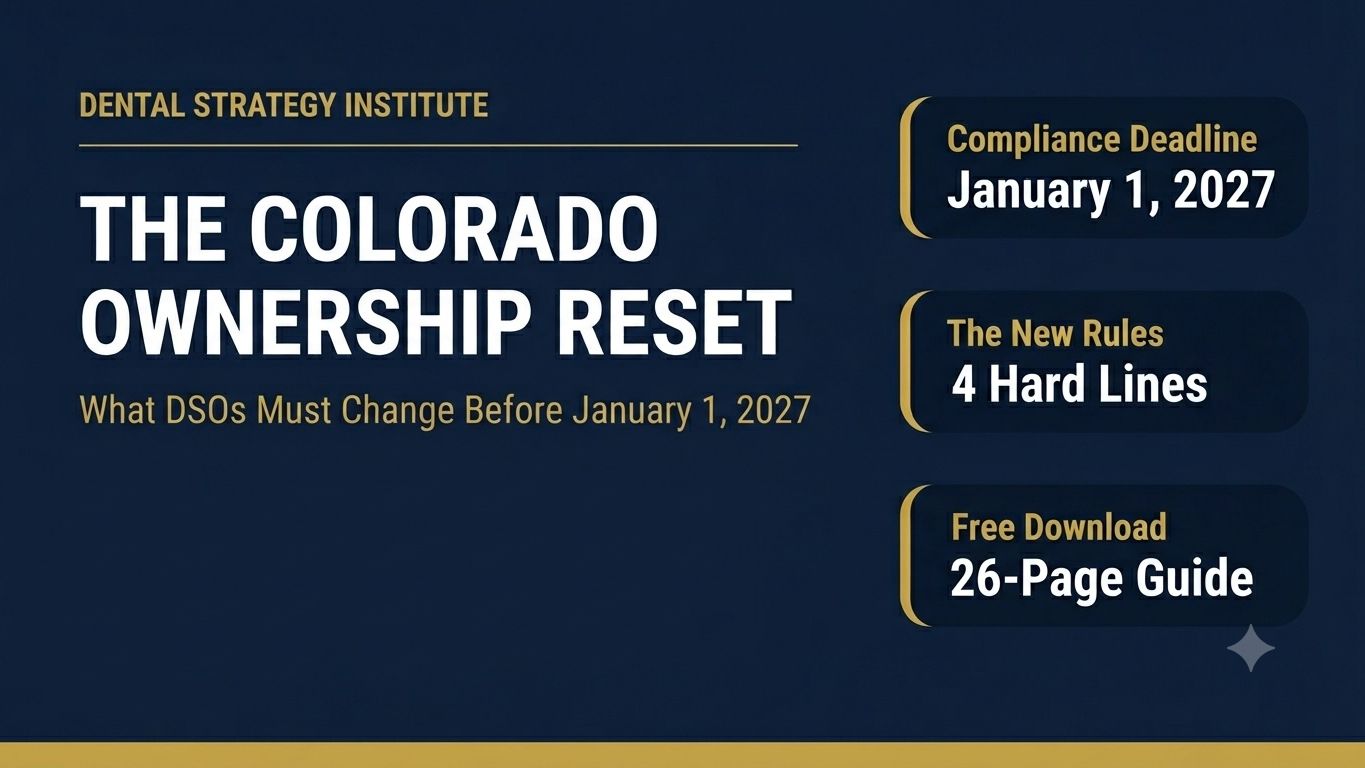
Equipment valuation has always mattered in dental transactions. Purchase price negotiations, CapEx forecasting, insurance schedules, M&A diligence — there have always been good reasons to know what your assets are actually worth.
As of January 1, 2027, there's a new reason. A legal one.
What Colorado's New Rules Actually Say About Equipment
The Colorado Dental Board's implementing regulations — built on Senate Bill 25-194, the Sunset Dental Practice Act — define a "Proprietor" as anyone who employs the licensed clinical team, owns the dental office, or owns the dental equipment and materials used to provide dental services.
That last clause is the one most operators missed.
A Proprietor is treated as practicing dentistry under Colorado law. And only a dentist can practice dentistry. So a DSO that owns the chairs, the delivery units, the digital sensors, the imaging systems — that DSO is, in the eyes of Colorado's regulators, practicing dentistry without a license.
The equipment has to move to the practice entity. Every operatory. Every location. Before January 1, 2027.
The Statutory Path That Keeps the DSO's Economics Intact
Before you interpret this as a forced write-off or a balance-sheet disaster, Colorado built in an exit ramp. The state's Dental Practice Act expressly carves out bona fide sales of dental equipment or material secured by a chattel mortgage or retain-title agreement.
In plain terms: the DSO can sell the equipment to the practice entity, hold a security interest on the note, and finance the transfer on whatever terms make sense for the platform. The practice owns the asset. The DSO holds the paper. Nobody is the Proprietor.
That's a workable structure. Most sophisticated platforms will end up there. But it has a prerequisite that most operators haven't addressed yet.
You need to know what the equipment is worth.
Why FMV Comes Before Everything Else
A compliant secured sale requires a sale price. A sale price requires a defensible valuation. And "defensible" in this context means something specific — not book value, not replacement cost, not a number someone pulled from a dealer quote. It means fair market value: what a willing buyer would pay a willing seller in an arm's-length transaction, given the asset's age, condition, and market comparables.
There are three reasons getting this number right matters enormously.
The transfer documents require it. When the DSO sells equipment to the practice via a chattel mortgage, the note has to reflect a real transaction at a real price. A number that's obviously inflated or obviously a token amount invites exactly the regulatory scrutiny you're trying to avoid.
The practice's balance sheet carries it. The practice now owns these assets. That affects the practice's borrowing capacity, its reported net worth, and how an acquirer values it at the next transaction. An inaccurate number creates problems downstream.
It will be questioned. Colorado regulators, opposing counsel in a dispute, or a future acquirer doing diligence can all ask: how did you arrive at this price? If the answer is "we used book value" on equipment that has depreciated 60% in market value, or "we used replacement cost" on equipment that's eight years old, you have a problem. A well-supported FMV opinion is your protection.
The Gap Between Book Value and Real Value
This is where the operational reality bites. Most DSOs carry equipment on their books at cost less accumulated depreciation — straight-line, over the IRS-defined useful life. It's an accounting construct, not a market signal.
The secondary dental equipment market doesn't care about your depreciation schedule.
A dental chair that cost $12,000 new and has been depreciated to $3,000 on the books might sell for $4,500 on the secondary market if it's in excellent condition with service records — or for $800 if it's a ten-year-old unit with no documentation in an unfamiliar brand. A CBCT scanner that cost $85,000 five years ago might retain $40,000 in market value or $15,000, depending almost entirely on brand, software version, and whether the detector has been replaced.
Book value and market value are different numbers. For compliance transfers, market value is the one that counts.
The gap between them is exactly what DentalAssetIQ was built to measure.
What DentalAssetIQ Brings to the Compliance Problem
DentalAssetIQ is a dental equipment intelligence platform that gives DSO operators, practice owners, and transaction advisors what hasn't existed before in one place: equipment-specific FMV data, lifespan benchmarks by asset class, and a depreciation framework calibrated to what the secondary market actually pays — not what an accounting standard assumes.
For the Colorado compliance problem specifically, DentalAssetIQ supports the process at every step.
Asset inventory. Before you can value anything, you have to know what you have. DentalAssetIQ's framework structures the inventory process by operatory and asset category, so nothing gets missed and every asset is described in terms that support a valuation.
FMV benchmarks by asset class. Chairs, delivery units, digital sensors, panoramic units, CBCT scanners, sterilizers, compressors, handpieces — each asset class depreciates differently and holds value differently. DentalAssetIQ's lifespan benchmarks and market-derived FMV ranges give you the data to price transfers accurately, by asset type and condition.
Depreciation methodology. The platform's depreciation curves reflect actual secondary-market behavior, not IRS tables. That's what makes the output defensible when someone asks how the number was derived.
CapEx exposure mapping. Once you know what the equipment is worth, you can see what it costs to keep it. Equipment that's deep into its service life and low in market value is a different financial conversation than equipment that's mid-life with strong residual value. DentalAssetIQ helps you see both dimensions before you execute any transfer.
The Checklist Most Operators Are Missing
A compliant equipment transfer in Colorado has a specific documentation footprint. Here's the sequence.
Step 1 — Complete asset inventory. Every piece of equipment at every Colorado location, with make, model, approximate age, service history status, and condition. Missing assets are missing value — and missing liabilities.
Step 2 — FMV determination by asset class. Use market-derived data, not book value. Document the methodology and the comparable data behind each valuation. DentalAssetIQ's benchmarks are built for exactly this purpose.
Step 3 — Structure the transfer. Choose between outright transfer (the practice owns it free and clear) and secured sale (chattel mortgage or retain-title). For most platforms with meaningful equipment balances, the secured sale path keeps the DSO's capital position intact while satisfying the Proprietor requirement.
Step 4 — Paper the transaction. Work with counsel to execute the sale documents, the security interest, and any UCC filings. This has to be a real transaction, not a paper fiction.
Step 5 — Update insurance schedules. The practice now owns the assets. The practice's insurance policy needs to reflect that. This is a step operators routinely forget until after a loss event.
Step 6 — Integrate into CapEx planning. The practice now carries equipment on its balance sheet, including the depreciation burden. The DSO's CapEx plan needs to reflect what happens when assets reach end of life and who funds replacement.
The Broader Picture
Equipment ownership is one of four hard lines Colorado drew. The DSO also can't hold the premises lease, can't employ the licensed clinical team, and can't own the practice itself. Each of those lines has its own compliance path. But the equipment line is uniquely data-dependent — it's the one that requires a number before you can move, and the one where an unsupported number creates the most downstream risk.
For the full structural picture — ownership, leases, clinical payroll, management fees, governance, and a complete 90-day action plan — the Colorado Ownership Reset guide from Dental Strategy Institute covers every piece. It's a free download at dentalstrategyinstitute.com.
Colorado isn't an isolated case, either. Dental Strategy Institute keeps a state-by-state tracker on where corporate-practice-of-dentistry law is moving next, and a companion piece on whether DSOs should actually pause Colorado acquisitions over any of this — short version, restructure instead of stalling.
For the equipment problem specifically, DentalAssetIQ is where to start.
Common Questions
When do Colorado DSOs need to transfer equipment ownership?
Before January 1, 2027, under the Colorado Dental Board's regulations implementing Senate Bill 25-194, the Sunset Dental Practice Act.
Can a DSO keep financial control of equipment after transferring ownership to the practice?
Yes. Colorado's Dental Practice Act allows a bona fide sale secured by a chattel mortgage or retain-title agreement, so the DSO can hold a security interest while the practice entity owns the asset outright.
What number does a compliant equipment transfer require?
A defensible fair market value, not book value or replacement cost. The transfer documents, the practice's balance sheet, and any future regulatory or acquisition review all rely on that price being real and supportable.
Related Reading
- DSO CAPEX Planning: A Data-Driven Framework for Equipment Replacement
- DSO Equipment Standardization: Why It Matters and How to Get There
- How to Prepare for a DSO Acquisition: Equipment Documentation Checklist
- What Your Equipment Age Is Doing to Your Practice Health Score
- Where Corporate Practice of Dentistry Law Stands in 2026 (Dental Strategy Institute)
- Should DSOs Pause Colorado Deals? (Dental Strategy Institute)
Free Download: The Equipment Compliance Checklist
We put together a complete checklist for the equipment side of Colorado DSO compliance — asset inventory framework, the chattel mortgage path explained, FMV documentation requirements, and the key questions to bring to your valuation provider.
→ Download the Colorado DSO Equipment Compliance Checklist — Free
No credit card. No catch. Instant access.
DentalAssetIQ is a dental equipment intelligence platform developed under the Dental Strategy Institute. Pete Volk, Founder of DSI and Director of Strategic Accounts at DCI Edge, has 25 years of experience in dental equipment, DSO strategy, and practice transactions.