
Dental Equipment Valuation: Why Book Value Is the Wrong Number — and What to Use Instead
Jun 09, 2026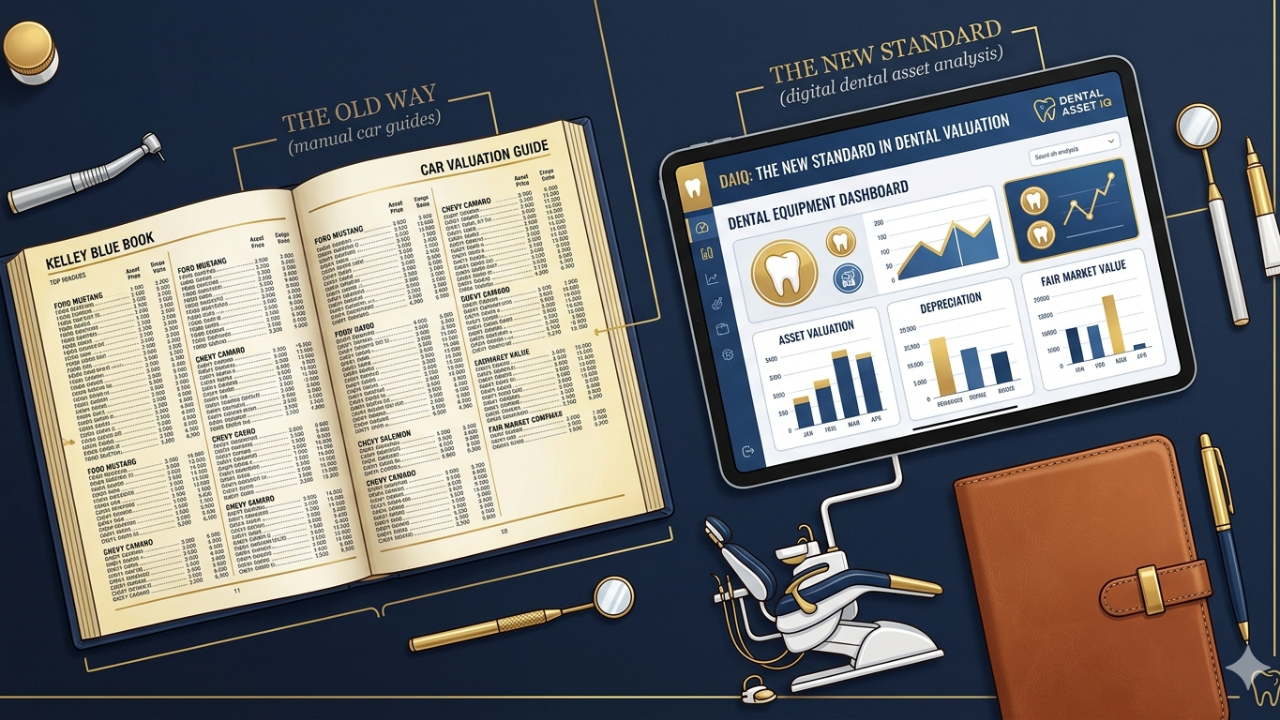
By DentalAssetIQ | June 2026 | 10-Minute Read | For DSO Operators, M&A Teams & Procurement Leaders
Every dental practice that changes hands, every DSO that acquires a location, and every insurance claim involving clinical equipment faces the same fundamental problem: someone needs to know what the equipment is actually worth today. Not what it cost when it was purchased. Not what the depreciation schedule says it is worth. What it would actually sell for between a willing buyer and a willing seller in the current dental equipment market.
These are three completely different numbers — and confusing them is one of the most expensive mistakes in dental practice transactions.
This article explains the difference, why it matters across seven distinct use cases, and how DentalAssetIQ provides the market-data infrastructure to produce defensible dental equipment valuations for DSOs, practice owners, M&A advisors, and procurement teams.
Three Values. One Asset. Completely Different Numbers.
Take a dental chair as a concrete example. A DCI Edge Series 5 chair purchased in 2019 for $18,500:
| Value Type | 2026 Figure | What It Represents | |---|---|---| | Original Cost | $18,500 | What was paid in 2019. Irrelevant to current value. | | Book Value (7-yr MACRS) | $0–$2,000 | What the accountant shows. Fully or nearly depreciated — but still a fully functional chair. | | Fair Market Value (FMV) | $6,500–$9,000 | What a buyer would pay in the current secondary market, based on actual comparable transactions. | | Orderly Liquidation Value (OLV) | $3,500–$5,500 | What the asset would bring in an organized sale with limited time. Used in distressed situations. | | MSRP (New Replacement Cost) | $22,000–$26,000 | Current new-unit price. Establishes the ceiling for FMV calculation. |
Example figures based on DentalAssetIQ market observation data, June 2026. Actual values vary by condition, location, and market.
"A chair with a book value of zero is not worth zero. A CBCT with a book value of $12,000 may be worth $65,000. Book value tells you nothing about the dental equipment market. Fair Market Value does."
Seven Situations Where Dental Equipment Valuation Is Non-Negotiable
1. Practice Acquisition and M&A Diligence
In any dental practice sale, the equipment component of the purchase price is negotiated based on its condition and market value — not its book value. Buyers routinely request equipment inspections and appraisals as part of diligence. Sellers who have a documented, defensible FMV are in a stronger negotiating position. Sellers who rely on depreciation schedules are at the mercy of whatever number the buyer's team produces.
For DSO platform acquisitions, this compounds: the buyer may be acquiring multiple locations simultaneously. Equipment condition and value across a fleet of 5, 10, or 20 locations can represent $1M–$5M+ in tangible asset value that must be independently assessed.
2. DSO Capital Planning and CAPEX Budgeting
DSOs managing 10–200+ locations need to know which equipment is approaching end-of-life and what replacement will cost — not just for one location, but across the entire platform. Without a systematic equipment valuation approach, CAPEX budgets are guesswork. With one, they are defensible forecasts tied to actual market replacement costs.
DentalAssetIQ's CAPEX Planning Module was built specifically for this use case: it scores every asset in the fleet by condition, age, and replacement priority, then projects replacement cost at current market FMV to produce a board-ready capital plan.
3. Insurance Coverage and Claim Readiness
Most dental practice insurance policies cover equipment at replacement cost or actual cash value. The distinction matters — and neither can be determined without a current equipment valuation. Practices that suffer a fire, flood, or theft and have never documented their equipment values are routinely underinsured. Their claim is settled based on whatever the adjuster determines, not what the equipment was actually worth.
4. SBA Loan Underwriting
SBA lenders financing dental practice acquisitions require a formal appraisal of tangible assets as part of the collateral package. Equipment that is accurately valued produces a stronger collateral position and can support a larger loan amount. Equipment undervalued on the schedule leaves money on the table for the buyer.
5. Partnership Buy-In and Buy-Out
When a dental associate partner buys into a practice, the tangible asset component of the buy-in price must be fair to both parties. An equipment valuation using book value consistently undervalues the seller's position. One using inflated replacement costs overcharges the buyer. Fair Market Value — supported by current market data — is the only defensible midpoint.
6. Divorce and Estate Proceedings
Courts require a credentialed appraisal of practice assets in divorce proceedings and estate valuations. Equipment valuation using book value is not accepted by most courts as a credible methodology. A market-based FMV determination, documented with comparable transaction data, is required.
7. Fleet Procurement Intelligence
For DSO procurement teams and group practice purchasing managers, knowing what equipment is worth in the secondary market is a competitive advantage in vendor negotiations, trade-in discussions, and equipment financing decisions. If your procurement team doesn't know the FMV of the assets they are replacing, they are negotiating blind.
How DentalAssetIQ Produces Dental Equipment Valuations
DentalAssetIQ is purpose-built for dental equipment valuation. The platform combines three data layers to produce FMV determinations for dental-specific assets:
1. Market Observation Pipeline
DAIQ continuously aggregates real transaction and listing data from active secondary dental equipment markets — including eBay sold listings, dealer resale platforms, manufacturer-certified pre-owned programs, dental-specific auction channels, and independent dealer inventory. Each observation is matched to a specific catalog record, normalized by condition tier, and stored as a verified market data point.
2. Equipment Master Catalog
The DAIQ catalog contains 3,500+ dental equipment records covering chairs, delivery systems, imaging equipment, sterilization units, handpieces, and auxiliary equipment from all major manufacturers — A-dec, DCI Edge, KaVo, Midmark, Dentsply Sirona, Planmeca, and 50+ additional brands. Each catalog record carries current MSRP data, model history, and market value benchmarks derived from the observation pipeline.
3. Valuation Engine (FMV / OLV / Market Benchmark)
The DAIQ valuation engine applies condition-adjusted depreciation curves to market observations to produce three value outputs for every asset: Fair Market Value (FMV), Orderly Liquidation Value (OLV), and a market-calibrated benchmark analogous to a Kelley Blue Book for dental equipment. Outlier filtering removes non-representative transactions. Category-scoped comparables ensure that a dental chair is compared only to comparable dental chairs.
KEY INSIGHT: DentalAssetIQ is not a general asset management platform. It is the only platform built specifically for the dental equipment secondary market — with catalog coverage, market data infrastructure, and valuation methodology designed for dental-specific assets. General equipment appraisal tools produce dental valuations using cost-less-depreciation, a methodology that does not reflect the actual dental equipment market.
The Equipment Categories That Drive the Biggest FMV Gaps
Not all dental equipment carries equal weight in a practice valuation. These categories consistently show the largest differentials between book value and Fair Market Value:
- Dental chairs and delivery systems: The single largest tangible asset in most practices. A practice with 5 A-dec 500 chairs (2020–2022 vintage) in good condition may have $60,000–$90,000 in FMV that a depreciation schedule shows as $15,000–$25,000.
- CBCT and 3D imaging systems: High-value assets with active secondary markets. Units from Planmeca, Dentsply Sirona, Carestream, and Vatech consistently hold value well beyond their depreciation schedules.
- Digital radiography: Sensor generations matter. A current-generation sensor suite is worth 2–3x a previous-generation system of equivalent age.
- Sterilization equipment: Midmark M9/M11 autoclaves hold market value extremely well relative to age-based depreciation. DAIQ market data consistently shows sterilizers appraising above book.
- Handpieces: High-value, frequently overlooked. A practice fleet of 20–40 KaVo or W&H electric handpieces may represent $15,000–$30,000 in FMV with zero book value.
For DSO Teams: Integrating Equipment Valuation into Your M&A Workflow
DSOs that have standardized equipment valuation into their acquisition diligence process consistently outperform those that treat equipment as an afterthought. The recommended workflow:
- Pre-LOI: Use DAIQ to run a preliminary equipment value estimate from the seller's equipment list. Identifies red flags — aging chairs, non-digital imaging — before you invest in full diligence.
- Full Diligence: Run a complete DAIQ equipment appraisal against the confirmed inventory. Produces FMV and OLV for every asset with comparables documentation.
- Purchase Price Allocation (PPA): Use DAIQ FMV outputs to support the tangible asset component of PPA for financial reporting and tax purposes.
- Post-Acquisition Integration: Upload the acquired location's equipment inventory to DAIQ's fleet management module. Track condition, schedule maintenance, and plan replacement CAPEX from day one.
- Annual Fleet Review: Run a DAIQ fleet valuation annually across all locations. Maintain a defensible FMV baseline for insurance, financing, and strategic reporting.
For practice-level financial strategy and transition planning resources — including guides on SEP IRAs, SIMPLE IRAs, and practice retirement planning — visit Dental Strategy Institute, DSI's resource library for dental practice owners preparing for major transitions.
The Bottom Line
Dental equipment valuation is not a one-number problem — it is a three-number problem: original cost, book value, and Fair Market Value. In every transaction, dispute, insurance event, or CAPEX decision that involves dental equipment, the only number that matters is Fair Market Value. And FMV requires actual market data, not a depreciation schedule.
For real-world examples of this exact gap — including a fully depreciated sterilizer still worth $2,000 on the open market — see How Much Is Dental Equipment Actually Worth?
DentalAssetIQ exists to make that number available — for every asset, in every practice, across every market condition.
→ Access DentalAssetIQ at app.dentalassetiq.com
Sources: ADA Health Policy Institute (2024); VMG Health, DSO M&A in 2026 (January 2026); Group Dentistry Now, DSO M&A Market Report (June 2026); Focus Investment Banking, Dental Practice Valuation Benchmarks (April 2026); DentalAssetIQ Market Observation Pipeline, Equipment FMV Data (June 2026)
© 2026 DentalAssetIQ. All rights reserved. | dentalassetiq.com