
The Procurement Director's Guide to Dental Fee Schedules in a Multi-Location Group
Jul 15, 2026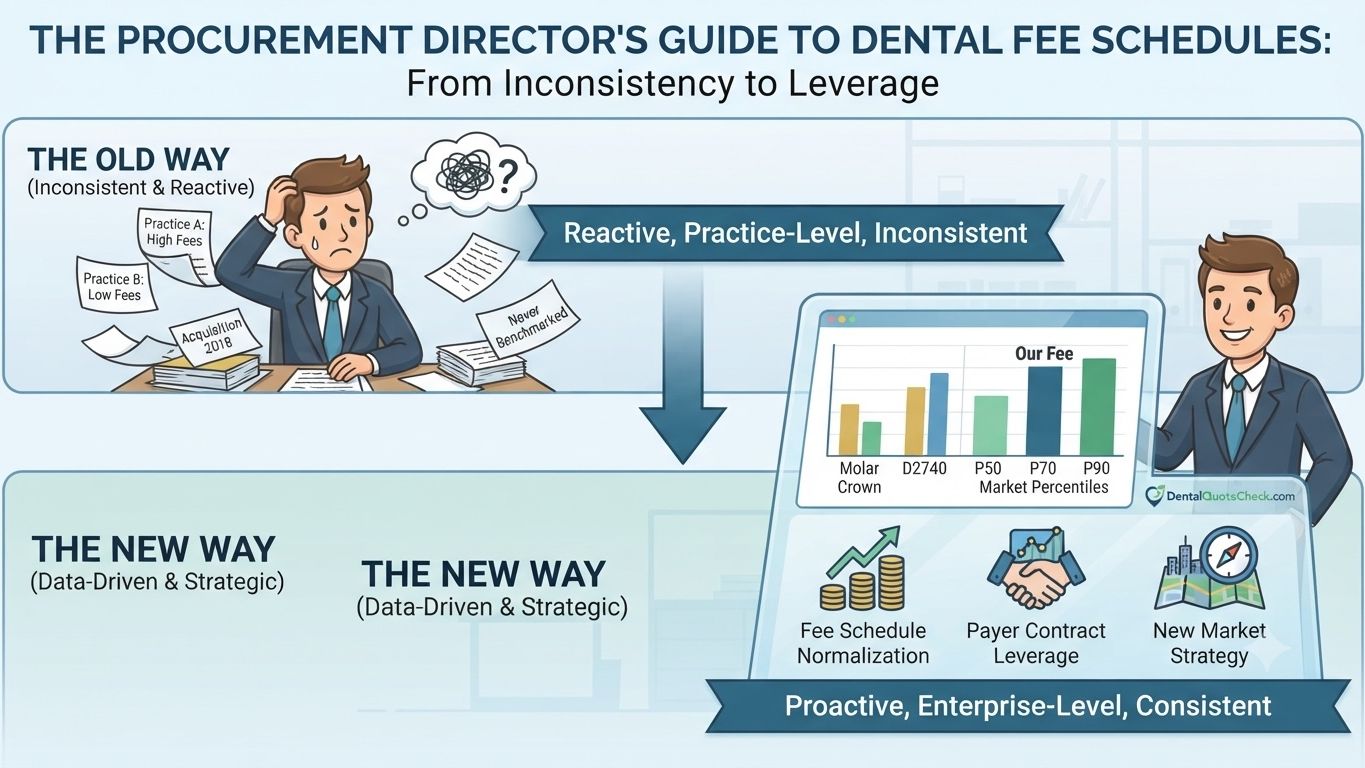
The Procurement Director's Guide to Dental Fee Schedules in a Multi-Location Group
Dental procurement at the enterprise level has gotten measurably more sophisticated over the last decade. Supply chain consolidation, GPO participation, equipment standardization, centralized credentialing — DSOs have built real operational leverage in most areas of the business.
Fee schedules remain a stubborn exception.
In most multi-location groups, fee schedules are still managed inconsistently: set at the practice level, inherited through acquisitions, updated reactively rather than strategically, and never benchmarked against a consistent external standard. The result is that two locations in the same metro area — serving similar patients, offering similar clinical services — can have fees that differ by 20% or more.
That inconsistency has a cost. Here's how to start managing it the way every other procurement function is managed: with data.
Why Fee Schedules Resist Standardization
Unlike supplies or equipment, dental fees aren't a line item on a purchase order. They sit at the intersection of clinical judgment, local market conditions, payer contracts, and patient psychology. That complexity gives operations teams a reason to leave fees alone.
That reason has also served as an excuse. The complexity is real, but it's manageable — and the financial impact of unmanaged fee schedules across a 20- or 30-location group is not trivial.
Consider: a 5% upward adjustment on crown fees (D2740 and D2750) across 25 locations performing 15 crowns per month each is a revenue difference of roughly $280,000 annually — assuming the fees were merely normalized to the local 60th percentile. That's not a price-gouging strategy. That's correcting underpricing.
A Framework for Enterprise Fee Schedule Management
Step 1: Benchmark every location against its local market. For each significant CDT code, compare the practice's current effective fee to the P50, P70, and P90 for its specific metro area. Flag outliers in both directions. This is your baseline.
Step 2: Establish a target range. Most enterprise groups target the 55th to 70th percentile for general dentistry, with specialist procedures allowing for higher positioning. Define your range explicitly — it becomes the standard every location is managed against.
Step 3: Separate UCR fees from effective fees. The stated fee schedule is not the revenue story. For managed care locations, the effective fee after insurance adjustments is what matters. Benchmarking UCR fees against a market that is largely managed-care creates a misleading picture.
Step 4: Build a rolling review cadence. Market fees shift over time. A quarterly or semi-annual review against current market benchmarks — not a one-time normalization — is what sustainable fee management looks like.
Step 5: Align payer contract strategy with fee positioning. If your fees are at the 65th percentile but your highest-volume PPO reimburses at the 45th percentile equivalent, that's a negotiation opportunity with a data-supported argument. The benchmark is the leverage.
Tools for the Analysis
Full fee schedule analysis at the enterprise level typically requires a qualified consultant or a proprietary data service. But for rapid market checks — evaluating a new acquisition target, cross-referencing a payer negotiation, or spot-checking a specific location — DentalQuoteCheck.com gives your team instant P50/P70/P90 benchmarks for any procedure and ZIP code at no cost.
Think of it as the quick-look instrument before you pull out the full analytical toolkit.
The Procurement Mindset Applied to Fees
Dental procurement teams have learned to treat supply costs, equipment costs, and labor costs as levers to be managed actively. Fee schedules are the one revenue-side lever that most teams still treat as fixed.
They are not fixed. They are a strategic variable. And in a competitive environment where most other operational efficiencies have already been squeezed, fee schedule optimization is one of the highest-return, lowest-capital initiatives available to a multi-location group.
The data to manage it is now accessible. The question is whether it's someone's job to use it.
Pete Volk is the founder of DentalAssetIQ and Dental Strategy Institute. He has spent 25 years in the dental industry working with practices, DSOs, and procurement organizations.