
How Dental Fee Data Should Factor Into Practice Valuations
Jul 13, 2026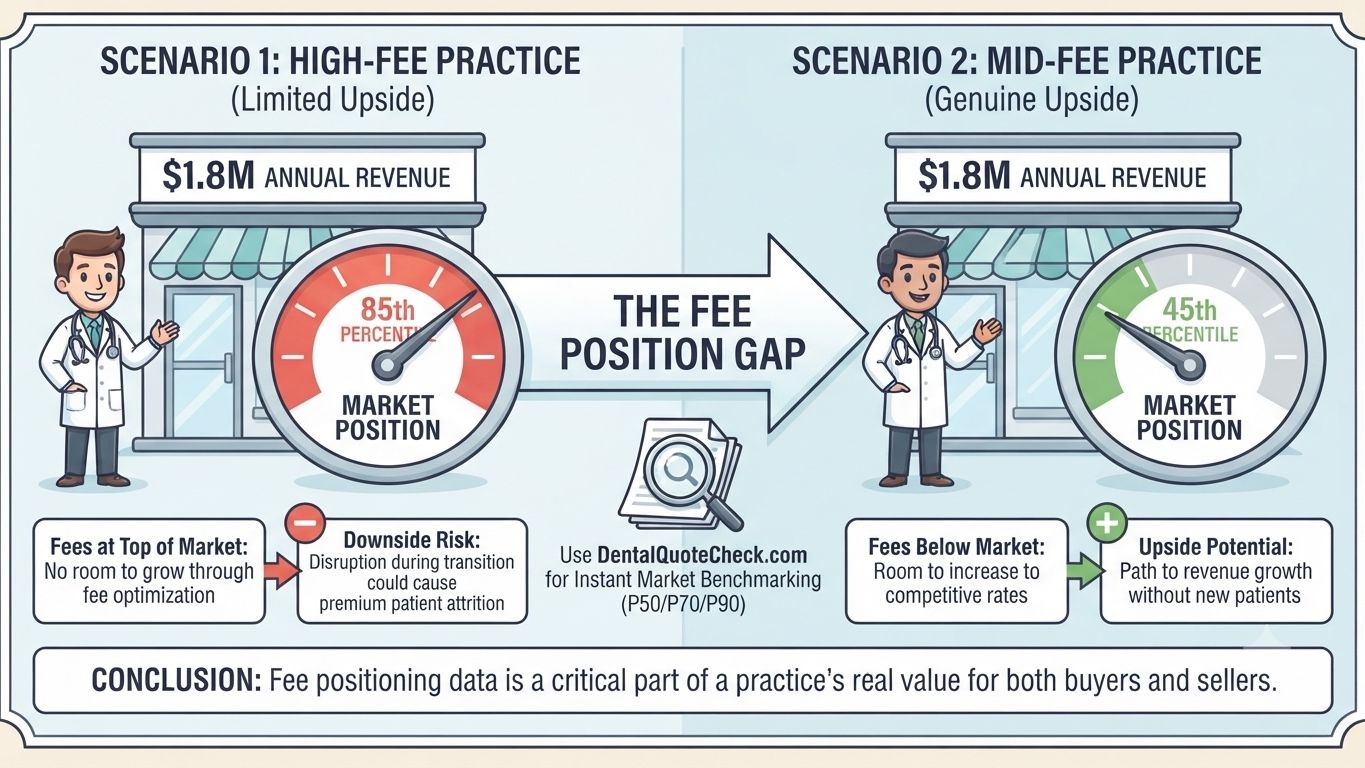
How Dental Fee Data Should Factor Into Practice Valuations
When a dental practice goes to market, the buyer's due diligence process covers a lot of ground: EBITDA, patient count, hygiene recall rate, payer mix, lease terms, equipment age, staff tenure.
One thing that rarely gets the attention it deserves: where the practice's fees sit relative to the local market.
That's a meaningful gap. Here's why fee positioning matters for valuation — on both sides of the transaction.
Fees as a Revenue Quality Signal
Not all revenue is equal. A practice generating $1.8M annually with fees at the 85th percentile of its market looks very different from a practice generating $1.8M with fees at the 45th percentile.
The high-fee practice has limited upside and meaningful downside risk. If fees are already at the top of the market, there's no runway to grow revenue through fee optimization. And if patient acquisition has been built on a reputation for premium pricing, any ownership transition that disrupts that positioning creates attrition risk.
The mid-fee practice is a different story. Fees at the 45th percentile in a market where clinical quality, patient reviews, and location support 65th-percentile pricing represent genuine upside. A buyer who recognizes this can build a realistic path to revenue growth without adding a single new patient.
Fee positioning, in other words, is part of a practice's real value — and most buyers aren't modeling it.
The Due Diligence Checklist Most Buyers Miss
Before any letter of intent, a serious buyer should be able to answer these questions:
What is this practice's effective fee for its top 10 CDT codes? Not the stated fee schedule — the effective fee after insurance adjustments and write-offs. These two numbers can diverge significantly in heavily managed-care practices.
Where do those fees sit relative to the local market's P50/P70/P90? For each procedure, does the practice price at, above, or below the market median? Is the pattern consistent, or are some procedures competitively priced while others are outliers?
What is the payer mix, and how does it constrain fee growth? A practice that is 80% managed care has limited ability to raise its effective fees regardless of where its UCR schedule sits. A fee-for-service or heavy PPO practice has far more pricing flexibility.
What would normalized-fee revenue look like? If fees were moved to the 60th or 65th percentile for this market — a defensible, competitive rate — what would that do to top-line revenue? This is the number buyers should be modeling in their proforma.
How DentalQuoteCheck.com Supports the Analysis
DentalQuoteCheck.com gives any buyer or advisor an instant benchmark for any procedure in any ZIP code — P50, P70, and P90 for the relevant market, by insurance type.
It's not a replacement for a full fee schedule analysis or a qualified appraiser. But as a rapid first-pass tool during initial due diligence, it answers the most fundamental question — is this practice priced above, at, or below market? — for free, in under a minute.
For associates exploring ownership, for DSO acquisition teams doing initial market scans, and for advisors building preliminary proformas, that's a meaningful data point that costs nothing to generate.
Both Sellers and Buyers Benefit From This Clarity
Sellers who know their fee positioning can make a cleaner case for their asking price. If your fees are at the 55th percentile with capacity for growth, that's a selling point — not a gap.
Buyers who benchmark fees during diligence avoid two expensive mistakes: overpaying for practices where fees have no room to grow, and undervaluing practices where fee normalization represents near-term, low-risk upside.
The data exists. The only question is whether you're using it.
DentalAssetIQ provides strategic resources, valuation insights, and educational content for dental practice owners, buyers, and advisors. Pete Volk is founder and a 25-year industry veteran.