
Dental Fee Benchmarking Is No Longer Optional for DSOs
Jul 10, 2026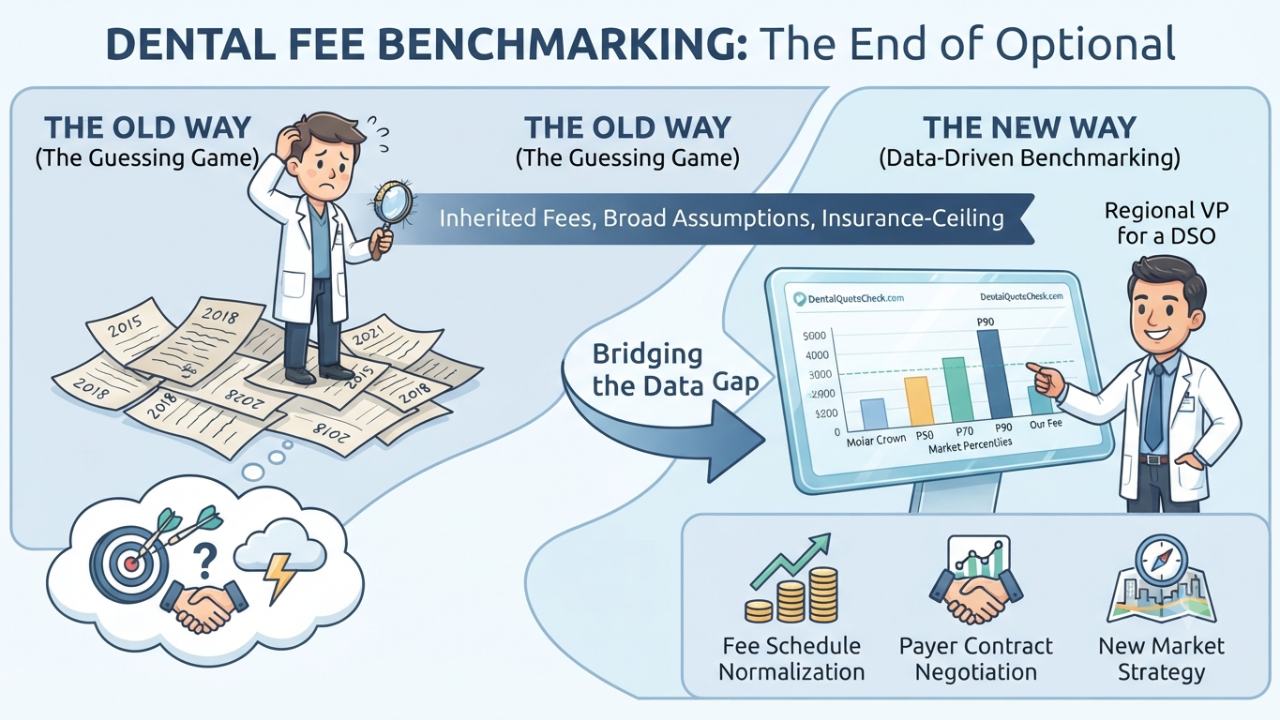
Dental Fee Benchmarking Is No Longer Optional for DSOs
For years, dental support organizations managed fee schedules the same way most of dentistry did: by asking around, looking at what insurance companies paid, and making educated guesses about what the market would bear.
That era is ending. And the DSOs that recognize it early will have a structural cost advantage over the ones that don't.
The Problem With How Most DSOs Currently Set Fees
The traditional approach to fee schedule management in a multi-location group has several failure modes:
Inherited fee schedules. When a DSO acquires a practice, it often inherits that practice's fee schedule — a schedule that may not have been updated in years, may not reflect current market rates, and almost certainly wasn't set with a 30-location enterprise in mind. Multiplied across dozens of acquisitions, this creates enormous fee inconsistency within a single organization.
Insurance reimbursement as the ceiling. Many DSOs benchmark their UCR fees against what their best insurance plans reimburse — essentially letting payers set the standard. This logic fails for out-of-network patients, self-pay patients, and any future fee renegotiation where you need to demonstrate market-rate justification.
Geographic assumptions that are too broad. A DSO with locations in Charlotte, Phoenix, and Chicago cannot apply a single fee schedule across all three markets. The cost structures, patient demographics, and competitive landscapes are materially different.
What Real Benchmarking Looks Like
Rigorous dental fee benchmarking means knowing, for each procedure and each market, where your fees sit relative to the 50th, 70th, and 90th percentile of market pricing. That answer changes by geography, by insurance type, and over time.
For a DSO, this analysis should drive three things:
Fee schedule normalization. Identify which acquired practices are significantly above or below market. Outliers on both ends represent risk — underpriced practices are leaving revenue on the table; overpriced ones face patient attrition and case acceptance challenges.
Payer contract negotiation. When you can demonstrate that your fees sit at the 65th percentile for a given market and procedure, you have a factual basis for renegotiating reimbursement rates. Payers respond to data. "We believe we deserve higher reimbursement" loses. "Our fees are at the 65th percentile and you're reimbursing us at the 48th" is a different conversation.
New market pricing strategy. Before opening or acquiring in a new geography, fee benchmarking tells you what the market will support, where competitors are priced, and where you need to position for your target patient demographics.
DentalQuoteCheck.com as a Rapid Benchmarking Tool
DentalQuoteCheck.com was built for patients, but its underlying data is immediately useful for procurement and operations teams doing rapid market assessments.
Enter any procedure and any ZIP code, and you get P50/P70/P90 benchmarks for that market instantly. It won't replace a full fee schedule analysis — but it gives your team a fast, free first look at any market you're evaluating, and a cross-check against the more expensive data sources you're already paying for.
For a regional VP evaluating a potential acquisition in a new metro, that's an asset.
The Competitive Advantage Is Compounding
DSOs that establish rigorous, data-driven fee management early will compound that advantage over time. More consistent case acceptance. More defensible payer negotiations. Cleaner acquisition integrations. A clearer value proposition in each local market.
Benchmarking dental fees used to require expensive consulting engagements or proprietary data subscriptions. The barrier to at least a directional answer is now zero.
The question is whether your operations team is asking it.
Pete Volk is the founder of Dental Strategy Institute and DentalAssetIQ. He has spent 25 years advising dental practices, DSOs, and procurement teams on strategy, valuation, and operational excellence.