
Dental Equipment Age vs. Condition: Which One Actually Drives Value?
Jun 06, 2026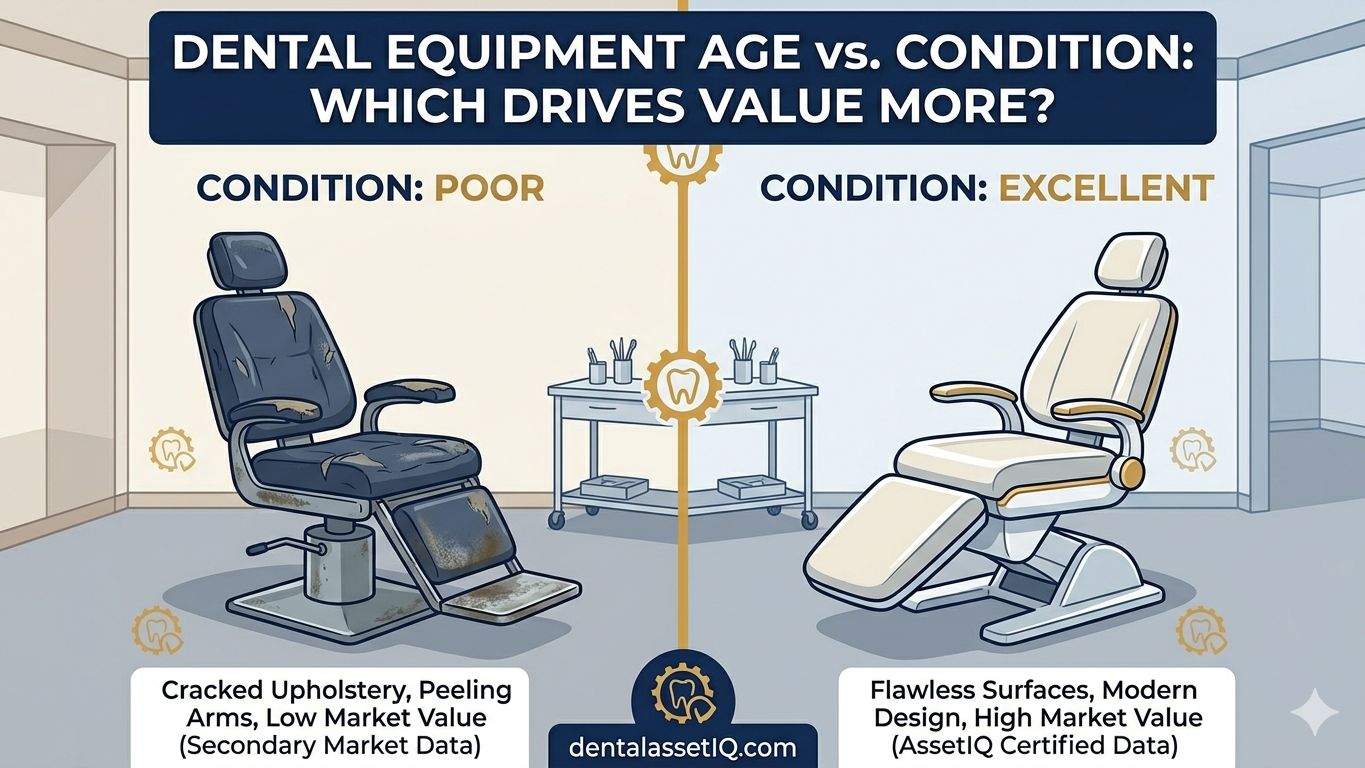
The Debate That Comes Up in Every Appraisal
Ask two dental equipment professionals what drives value more — age or condition — and you'll get an argument.
The truth: both matter, but they interact in ways that most valuations get wrong.
Understanding the age-condition relationship is the key to not over- or under-valuing dental equipment in any transaction, insurance claim, or capital planning exercise.
How Age Works in Dental Equipment Valuation
Age drives value through two mechanisms:
1. Expected useful life remaining
Every equipment category has a typical useful life range. When you're past the midpoint of that range, value declines more steeply because the buyer's risk increases.
| Category | Useful Life Range | High-Depreciation Zone | |---|---|---| | Patient Chairs (hydraulic) | 15–25 years | Year 13+ | | Patient Chairs (electromechanical) | 7–12 years | Year 7+ | | Air Compressors | 8–15 years | Year 9+ | | Panoramic X-Ray (digital) | 8–12 years | Year 9+ | | CBCT Systems | 7–10 years | Year 7+ | | Sterilizers (autoclave) | 15–20 years | Year 14+ | | Digital Sensors | 5–8 years | Year 5+ | | Delivery Systems | 15–20 years | Year 14+ |
For detailed useful life benchmarks from the manufacturer perspective, see How Long Does Dental Equipment Actually Last? on the Dental Strategy Institute blog.
2. Technology obsolescence
Age matters differently in technology-dependent equipment. A 12-year-old Midmark M9 UltraClave is a known, reliable machine — age affects it primarily through wear. A 12-year-old digital sensor is likely running on unsupported software. Same age, very different value trajectory. See our Dental Sterilizer Valuation guide and CBCT Scanner Depreciation guide for category-specific detail.
How Condition Works
Condition is applied as a multiplier against the baseline FMV for a given make, model, and age. DentalAssetIQ uses a five-tier condition scale:
| Condition | Multiplier | Description | |---|---|---| | Mint | 1.10 | Like new, low use, often with warranty transfer | | Excellent | 1.00 | Normal wear, fully functional, maintained | | Good | 0.65 | Visible wear, functional, may need minor service | | Fair | 0.30 | Significant wear or known issues; functional but near end | | Parts | 0.10–0.15 | Non-functional or beyond economical repair |
The gap between Excellent and Fair is 70% of value. See our Dental Chair Fair Market Value guide for how condition plays out on specific models.
Why Age Alone Is Unreliable
Consider two DCI Edge chairs, both purchased in 2016:
Chair A: High-volume orthodontic practice — 10+ patients per day, no service records, upholstery worn. Condition: Fair. FMV: $1,100–$1,600.
Chair B: Periodontal specialist office — 4–5 patients per day, annual service contract, recently reupholstered. Condition: Excellent. FMV: $3,000–$4,200.
Same age. Same brand. Same model. Nearly 3x difference in value.
This is why any valuation that relies solely on purchase date and straight-line depreciation is wrong. See Dental Equipment Depreciation vs. Market Value for a full breakdown of why book value diverges from market value — and what that means in practice sales.
Why Condition Alone Is Also Unreliable
A perfectly maintained 2008 film-based panoramic X-ray in immaculate condition has FMV approaching zero. Its technology is obsolete. Condition can't rescue an obsolete category.
See our Panoramic X-Ray Value guide and Used Dental Equipment Prices guide for how this plays out in specific categories.
The DentalAssetIQ Approach: Age × Condition × Market
The correct valuation model integrates all three factors:
- Start with real market comps for that specific make and model
- Apply age-based depreciation to establish a baseline for that cohort
- Apply condition multiplier against that age-adjusted baseline
- Weight by market confidence — how many real comps exist?
The Dental Strategy Institute's article on Dental Equipment Depreciation covers the accounting side of this in more depth.
Related Reading
- Dental Equipment Depreciation vs. Market Value
- Dental Chair Fair Market Value: DCI Edge, A-dec & Midmark
- Used Dental Equipment Prices: What's Selling in 2026
- Dental Panoramic X-Ray Value
- Dental Air Compressor Value
- DSI: How Long Does Dental Equipment Actually Last?
DentalAssetIQ integrates age, condition, and real market transaction data to produce defensible FMV estimates for 3,500+ dental equipment models.
Try it free at app.dentalassetiq.com
— Pete Volk, Dental Strategy Institute