
Case Acceptance Is a Pricing Problem More Often Than a Sales Problem
Jul 17, 2026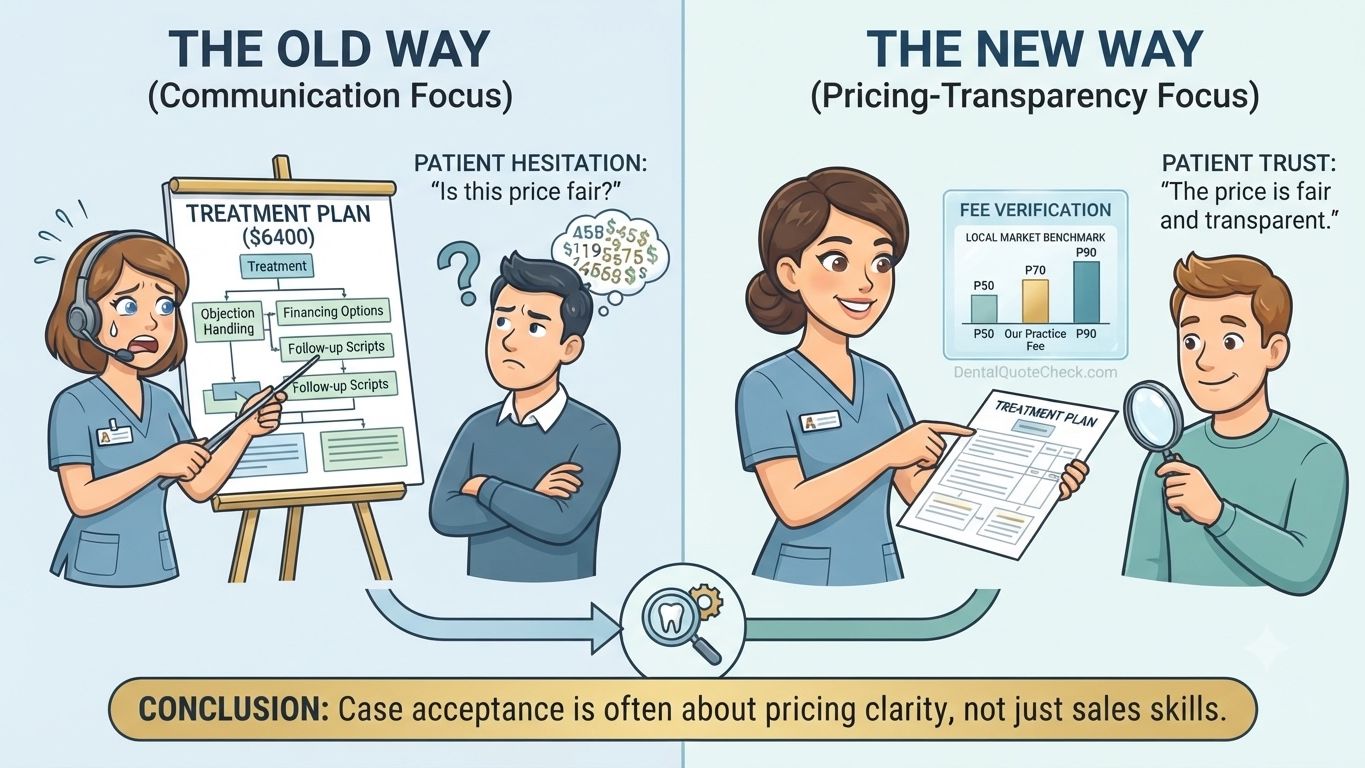
Case Acceptance Is a Pricing Problem More Often Than a Sales Problem
The dental industry has spent considerable energy training treatment coordinators to sell. Scripts, objection handling, financing presentations, follow-up sequences. The implicit assumption behind all of it is that case acceptance is primarily a communication problem.
In many practices, it's a pricing problem. And no amount of scripting fixes that.
What the Data Actually Shows
Research consistently shows that the leading reason patients decline recommended treatment is cost. Not fear. Not inconvenience. Not lack of trust in the clinical recommendation. Cost.
When a patient is presented with a $6,400 treatment plan and walks out the door without scheduling, the most common explanation isn't that the treatment coordinator failed to build sufficient rapport. It's that the patient has no frame of reference for whether $6,400 is reasonable — and in the absence of that context, hesitation is rational.
Patients don't know if they're being charged fairly. And uncertainty, in healthcare as in most consumer decisions, defaults to inaction.
The Connection Between Market Positioning and Case Acceptance
There is a meaningful correlation between how a practice is priced relative to its local market and its case acceptance rates — though it rarely shows up in the KPIs most practices track.
Practices priced at or below the local 60th percentile tend to see higher case acceptance, not because their patients are less price-sensitive, but because the price point doesn't trigger the skepticism that above-market fees do.
Practices priced in the 80th to 90th percentile can absolutely maintain strong case acceptance — but only when the value proposition is communicated clearly and credibly. When it isn't, the high fee becomes the whole story, and the whole story doesn't close.
The treatment coordinator in the second scenario isn't failing. They're being handed an objection that should have been addressed upstream, at the fee-setting level.
What Practices Can Do Differently
Know your market position. Before your next team meeting on case acceptance, run your most common procedures through DentalQuoteCheck.com for your ZIP code. Know whether your fees are at the 50th, 70th, or 90th percentile. That number changes the conversation.
If you're below market: You may have room to adjust fees upward without affecting case acceptance. Many practices discover they've been systematically underpriced — leaving revenue on the table while not improving case acceptance, because patients don't perceive below-market fees as a bargain; they just accept them as normal.
If you're at or near market: Your case acceptance challenges are genuinely about communication, trust, and patient financing. Lean into those solutions.
If you're above market: You need to close the value gap. What does the patient get for the premium that they can't get elsewhere? If you can't answer that concisely, your treatment coordinator can't either.
Empowering Patients to Verify Fairness
There's a counterintuitive strategy that some practices are beginning to use: proactively sharing benchmarking tools with patients.
A treatment coordinator who hands a patient a printed treatment plan and says "we encourage you to verify that our fees are competitive — here's a tool that lets you check" is making a powerful statement. It says: we priced this with integrity, and we're confident enough to invite scrutiny.
Most patients won't use the tool. But knowing it exists removes the uncertainty that drives inaction. The objection dissolves before it's raised.
That's not a sales technique. That's a trust architecture.
DentalAssetIQ provides strategic resources for dental practice owners, DSOs, and investors. Pete Volk is founder and a 25-year veteran of the dental industry.